The Ecology of Attention
What does meaningful presence look like in an increasingly synthetic environment?
Part personal story and part reflection on the future of communication, this piece considers what becomes possible when we stop treating ourselves like machines built for constant output and begin creating the conditions that allow human systems to remain adaptive, relational, and alive.

Over the last few weeks, I found myself seriously considering deleting all social media accounts entirely.
Part of that came after discovering that my Instagram account had been replicated by what appeared to be an AI-generated impersonation account that began following hundreds of people connected to my actual community. What followed was days of reporting, confusion, messages from friends and peers asking whether it was me, and the strange experience of trying to convince a platform that a direct imitation of your identity should perhaps warrant concern.
The account was eventually removed, thankfully. But the experience stayed with me longer than I expected. Not simply because it was unsettling, although it was. More because it forced me to confront a larger question I have already been wrestling with quietly for years now:
What does meaningful presence look like in an increasingly synthetic environment?
I understand the value of digital platforms. They allow people to share ideas, build community, find support, exchange knowledge, and connect across geographic boundaries in ways that would have been impossible not long ago. Much of the work I have been able to do professionally exists because of those possibilities.
At the same time, I think many of us can feel that something about the ecology of these spaces has changed. What’s become unsettling is the fast pace, the intense volume, the performative pressure, the collapse of context, the constant demand for visibility, and the way algorithms increasingly reward reaction over depth, certainty over curiosity, optimization over relationship. And now, increasingly, the blurring of what is even real is raising concerns.
I do not say this from a place of superiority. I have participated in it, too. Years ago, I approached social media strategically and systematically through editorial calendars, scheduled content, cross-platform consistency, engagement strategies, analytics, and planned visibility. At times, it worked well. But over time, especially through illness, grief, injury, surgery, burnout, and recovery, I started questioning not only what I was sharing, but the conditions I was participating within while sharing it.
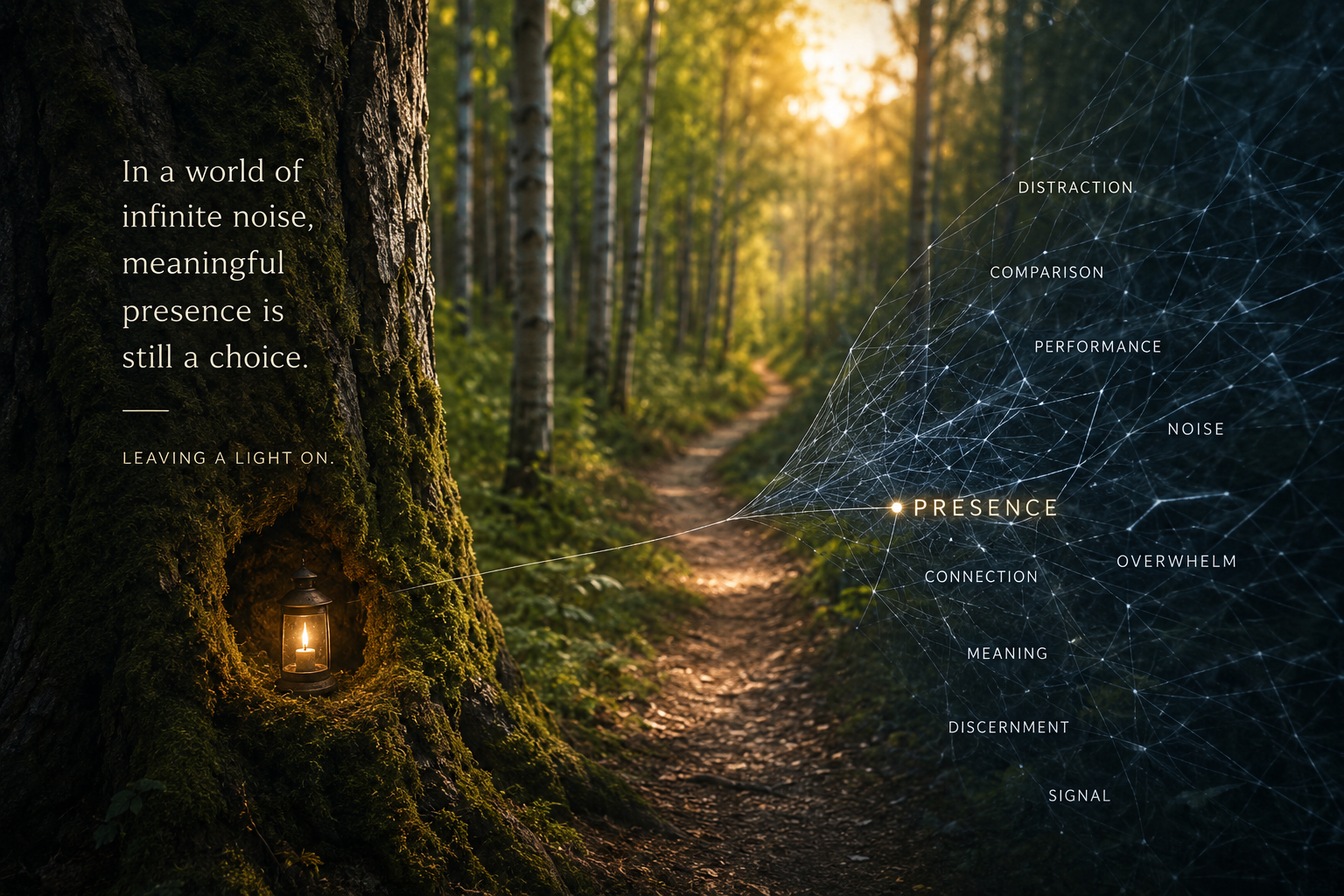
Living systems depend on signal integrity. In nature, organisms survive through their ability to interpret meaningful signals from noise: shifts in temperature, light patterns, resource availability, danger, seasonal change, relational feedback, and ecological imbalance. When signals become distorted or overwhelming, systems lose coherence. Regulation becomes more difficult. Adaptation becomes less efficient. Resources become misallocated.
I do not think humans are exempt from this simply because the signals are now digital.
Much of modern online life asks us to remain continuously exposed to an environment our nervous systems did not evolve to process at this scale or intensity. Endless input. Endless comparison. Endless stimulation. Endless opportunities for both connection and dysregulation exist simultaneously.
And for many people, especially those navigating healing, grief, chronic stress, burnout, trauma, illness, or major life transitions, discernment becomes essential. Not all visibility is nourishing. Not all connections feel safe. Not all attention is care. That does not mean withdrawing completely is the answer either.
One of the more complicated realizations I have had recently is that I still deeply believe in the importance of sharing knowledge, stories, and lived experience. I still believe education matters. I still believe thoughtful communication can help people feel less alone. I still believe there is value in documenting what we are learning while we are learning it. What I no longer believe is that meaningful work necessarily requires constant performance.
Over the last few months, while recovering from major surgery and navigating a far more complicated healing process than I anticipated, my relationship with visibility changed significantly. My energy became more precious. My nervous system became more honest. The gap between what generated engagement and what actually felt sustainable became impossible to ignore. And yet, interestingly, this same season has also made me want to engage with people more directly and more locally again.
This looks like more real human connection with more conversations, more walking, more shared learning, more community, and more time spent in environments where bodies, voices, facial expressions, pacing, and actual presence still exist together in physical space.
I think that is part of why my work has also become more grounded over time. For those unfamiliar with my background, my practice sits at the intersection of systems thinking, health, resilience, biomimicry, behavior change, movement, nervous system regulation, and human adaptation. Biomimicry, at its core, is the practice of learning from living systems and applying those principles to human challenges. Over the years, that perspective has profoundly shaped how I understand healing.
Nature rarely relies on endless force. Living systems adapt through responsiveness. Capacity fluctuates. Recovery is rhythmic. Sustainability depends on conditions. Those principles increasingly shape not only how I approach health and coaching, but also how I approach communication itself.
I no longer want to build a digital presence that requires me to override my own biology in order to maintain it. I want my work to function more like a living system: adaptive, relational, responsive, grounded, and capable of evolving honestly over time. That likely means slower growth, smaller communities, more word of mouth, more trust-building, and more in-person engagement here in Denver as my body continues healing and rebuilding strength again. And honestly, I think I am okay with that.
There is also something important I want to say clearly for anyone who has quietly followed my work over the years but hesitated to reach out. I understand what it feels like to need support during seasons where capacity is limited financially, physically, emotionally, or otherwise. The last several years have reinforced for me how deeply healing depends on reciprocity, community, and people willing to help hold one another through difficult seasons of life.
While I believe deeply in valuing this work appropriately and creating sustainable structures around it, I also never want cost, shame, or assumptions about affordability to prevent someone from beginning a conversation. If something in my work resonates with where you are right now, you are welcome to reach out.
For now, the platforms will remain, though my relationship with them has changed. You’ll see fewer posts, fewer updates, and less emphasis on maintaining a constant stream of visibility. I still believe there is value in leaving a light on for those who may be searching for ideas, support, or a reminder that they are not alone. But increasingly, the work itself is happening elsewhere: in conversations, walks, coaching sessions, community gatherings, collaborative projects, and the slower process of building genuine relationships. Social media may continue to serve as a signal that I am here, but I no longer want it to be mistaken for the substance of the work. The connection I care most about exists beyond the feed.
As I slowly return to fuller capacity this summer, I am opening space for a small number of additional clients and collaborative opportunities focused on health, resilience, recovery, nervous system regulation, movement, life transitions, systems thinking, and sustainable approaches to human wellbeing.
And perhaps more than anything, this season is simply teaching me to become more intentional about where I place my attention, my energy, my voice, and my care.
Not all growth needs to happen publicly. Not all connections need algorithms. Not all meaningful work needs scale. Sometimes the most regenerative systems grow slowly, locally, relationally, and with enough integrity to remain alive over time.
An Invitation to Notice
Living systems survive by learning which signals matter. As you move through the coming week, consider setting aside a few quiet moments to reflect on the following:
What is currently receiving most of my attention?
Which parts of that feel nourishing, meaningful, or aligned with who I want to become?
Which parts feel more like noise, obligation, distraction, or habit?
Where do I feel most present, connected, and fully myself?
What relationships, environments, or practices help me feel more alive?
What would it look like to place just a little more attention there?
Living systems rarely transform through force. More often, they adapt through small shifts in where energy, resources, and attention are directed over time. Perhaps the question is not how to do more. It is: what deserves our attention in the first place?